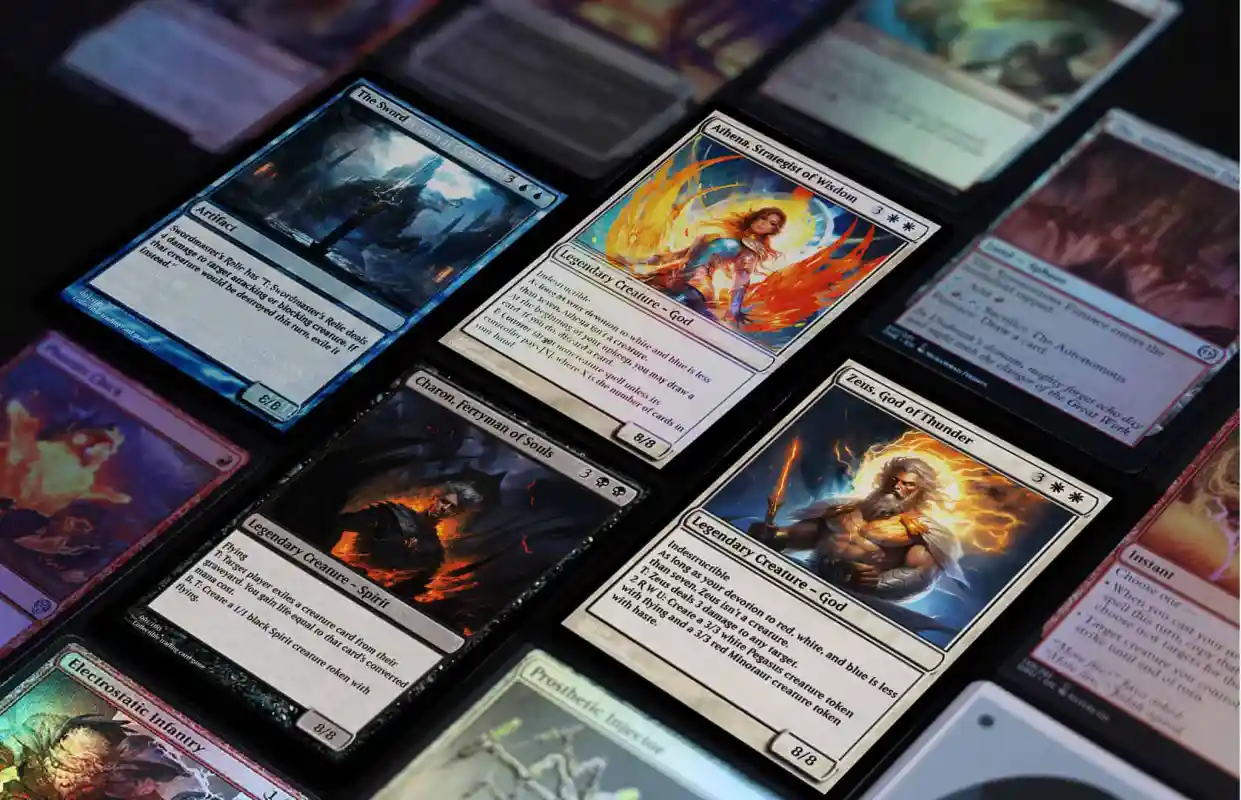
Creating your own collectable card game, or TCG (Trading Card Game), is a project accessible to strategy game enthusiasts, independent authors and board game designers. However, from the initial idea, through the rules, card balancing and production, several steps are required to produce a game that is actually playable.
Whether you want to create a game in the style of Magic: The Gathering, Pokémon or Disney Lorcana, or develop a completely original universe, card prototyping TCG is an essential step before any mass production. Here’s how to turn your concept into your first tangible card game, without having to invest a large budget straight away.
1. Define the concept and rules of your TCG
Before creating the illustrations, decide what makes your game different. Its setting could be fantasy, futuristic, historical or humorous. However, its identity must also be based on original game mechanics.
Start by answering five questions: how many players can take part? How do you win a game? How do players obtain their cards? What resources are needed to play cards? What strategic decision makes your game interesting?
Let’s take the example of a TCG fantasy medieval game in which each player commands a faction. The cards represent units, equipment and events. Each player has 20 health points and uses a resource called ‘mana’ to deploy their creatures.
This is all you need to draft an initial version of the rules. There’s no point in writing a 50-page manual before you’ve checked that the concept works and, above all, that it’s easy for everyone to understand!
2. Designing your first playing cards
A collectable card game relies not only on the variety of cards, but also on how they complement one another. It is therefore essential to establish a coherent structure before producing hundreds of different items.
For an initial prototype, a set of 40 to 60 different cards is a practical starting point, though this is by no means a hard and fast rule. Plan for several categories: offensive units, defensive units, support cards and special effects.
Each card must display clear and consistent information: name, cost, characteristics, effect, rarity (if applicable) and illustration. Use standardised graphic templates so that players can quickly identify the key information.
Software such as Canva, Affinity Designer or Inkscape can be used to create initial designs. A spreadsheet is also useful for keeping track of each card’s characteristics and effects.
For example, a unit costing two resources might deal three damage, whilst a unit costing four resources might have more health points or a special effect. These values are provisional: test games will be used to check whether they are balanced.
3. Prototyping your card game without spending a fortune
The first prototype doesn’t need to look good. Above all, it must allow you to play.
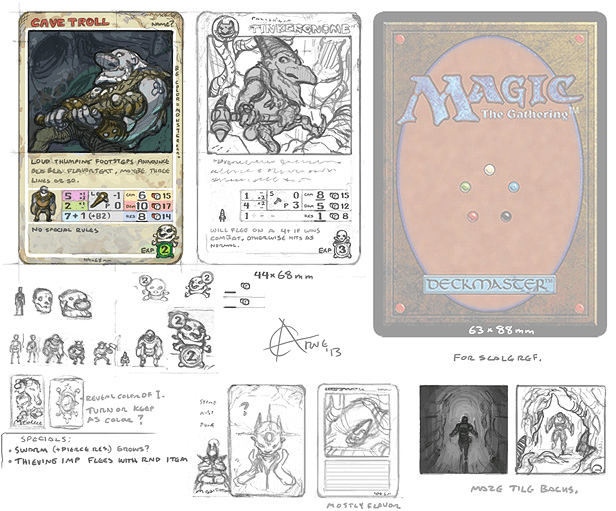
A cost-effective solution is to print the cards on standard paper, cut them out and then slip them into card sleeves containing unused standard playing cards. This method allows you to quickly change the effects without having to reprint a whole set.
This approach is consistent with professional practice. In its article on test cards, Wizards of the Coast explains how Magic designers use blank or annotated cards to experiment with their mechanics.
Once the rules start to take shape, a colour print becomes useful for assessing readability, the hierarchy of information and ease of use.
To produce a more representative prototype, several factors are important: the card size, the paper weight, the print quality, the finishes and the precision of the cutting. The poker size, measuring 63.5 × 88.9 mm, is used in particular for many collectible card games.
Double-sided printing allows you to check the alignment of the sides, whilst lamination can make the finish more similar to that of a commercially produced card. However, these finishes are not essential for the first attempt.
For an independent project, having a few dozen or a few hundred cards printed often offers an attractive balance between cost, quality and flexibility in making changes.
4. Testing and balancing game mechanics
A prototype does not become a good game simply because its rules seem coherent on paper. You need to observe players in real-life situations.
Organise several games with different types of players: experienced players, beginners and people who are unfamiliar with your game’s universe. Make a note of the duration of the games, cards that are rarely used, effects that are too powerful and situations in which a player is unable to react.
Imagine, for example, that a card costing one resource allows you to deal five damage without any cost to yourself. If this card consistently dominates games, its cost or effect needs to be reviewed.
Change one variable at a time and keep a version history. This will enable you to identify which changes are genuinely beneficial.
This iterative approach is also highlighted by Mark Rosewater, a designer at Wizards of the Coast: testing allows design assumptions to be tested against actual gameplay.
5. Refine the design before launching a small batch
Once the mechanics have been finalised, focus on the visual quality. The illustrations should enhance the game’s world, whilst the typography, icons and colours should make the game easier to follow during play.
Also check that the text remains legible at the actual size of the cards. Text that looks fine on a screen can become difficult to read once printed.
At this stage, prepare high-resolution files, ideally at 300 dpi, allowing for the bleed required for cutting. For professional production, check the exact specifications with your printer.
You can then produce a more polished prototype, intended for demonstrations, testing with specialist shops or presenting your project to partners.
Please also ensure that the rights relating to illustrations, fonts and graphic elements are clarified before any products are marketed.
6. Preparing for production TCG
Moving from prototype to production involves striking a balance between budget, quality and quantity. A small batch allows the product to be tested with players without tying up large sums of money in stock.
Bear in mind the cost of the cards, as well as that of the packaging, printed rules, boxes and any additional cards. If your game is regularly updated, the ability to produce small quantities becomes particularly useful.
It is also important not to confuse prototypes with finished products: the durability of the cards, the finishes, colour consistency and cutting precision must all be checked on physical samples.
Press Start Print supports card game designers in producing prototypes and small batches specifically designed for playtesting. This approach enables projects to be brought to life, their potential to be tested and the product to be improved before moving on to larger-scale production.
Conclusion: bring your card game to life
Creating a TCG requires a well-defined approach, extensive testing and effective cost control. First, define your rules, design a limited set of cards, produce a low-cost prototype and have it tested by other players.
Don’t expect to create a perfect game straight away. Every game should provide you with useful feedback to help improve the balance, mechanics and design.
Once the basics have been finalised, printing more polished prototypes will enable you to present your project in the best possible light and prepare for the next stages of its development.